Nauka nie śpi
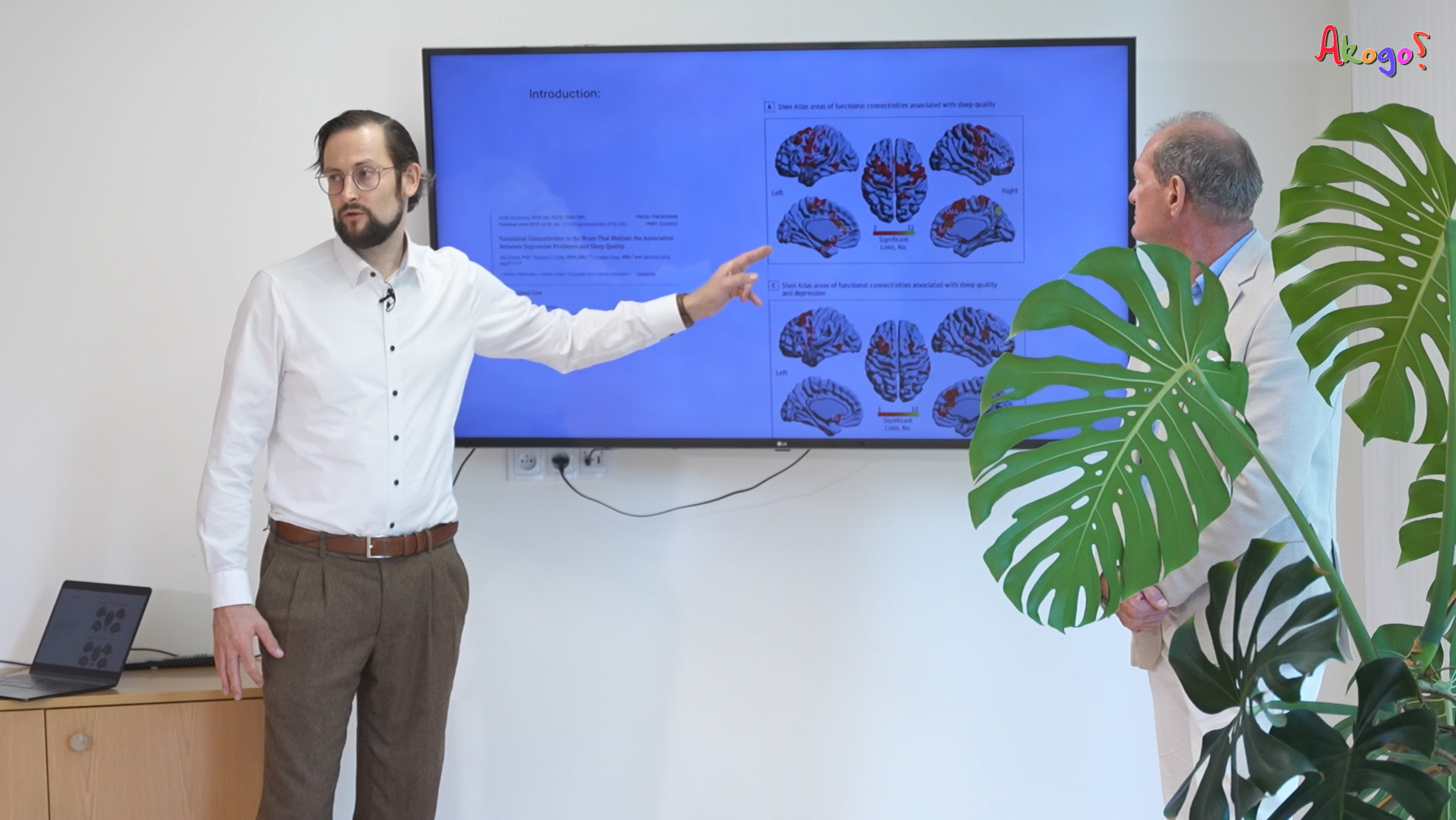
On August 19th, at the “Alarm Clock” Clinic for adults, at the invitation of the “Akogo?” Foundation, a meeting was held with the participation of distinguished scientists and doctors.
We hosted Dr. Felix Bernhard, neurologist and research team leader from the University of Marburg (Germany), as well as Dr. Anna Duszyk-Bogorodzka and Prof. Piotr Durka from the Department of Biomedical Physics, Faculty of Physics, University of Warsaw.
The meeting was opened by Dr. Anna Duszyk-Bogorodzka, who presented the latest research on sleep in patients with disorders of consciousness.
Sleep – essential for brain recovery and functioning – may be linked to consciousness itself.
The research team demonstrated that characteristic features of sleep (so-called sleep spindles and slow oscillations) appear more frequently in patients in a minimally conscious state (MCS, eMCS), while they are almost absent in those in an unresponsive wakefulness state (UWS). This indicates that sleep studies can support more accurate diagnoses of a patient’s condition and help predict their chances of regaining consciousness.
Next, Dr. Felix Bernhard, a specialist in modern methods of studying brain activity, took the floor. He leads the Neuromodulation Lab in Psychiatry in Marburg (https://www.psycontrol-lab.de), where together with his team he develops the application of fNIRS (functional near-infrared spectroscopy).
fNIRS is a safe and non-invasive technique that allows us to literally “look inside” the working brain. A headband or cap equipped with near-infrared light emitters is placed on the patient’s head.
The light penetrates a few centimeters into the skull, reflects off tissues, and returns to sensors. This makes it possible to measure changes in blood oxygenation in different areas of the brain. Since active neurons require more oxygen, this method allows researchers to identify which brain regions respond, for example, to sounds, commands, or stimulation.
Dr. Bernhard, in his ongoing work shows how fNIRS can help optimize tVNS therapy (transcutaneous vagus nerve stimulation) – a method already used today, among others, in the treatment of depression.
The combined use of both technologies offers the chance to tailor therapy more precisely to the individual needs of each patient.
Dr. Bernhard’s research opens new perspectives for personalized treatment methods – from psychiatry to neurology, and also for patients in coma.
The meeting marked the beginning of scientific collaboration between Dr.Bernhard’s team and the researchers working with the “Akogo?” Foundation and the „Alarm Clock" Clinics. The shared goal is to design future studies to explore whether the combination of fNIRS and tVNS could support therapies for patients with disorders of consciousness.
We hosted Dr. Felix Bernhard, neurologist and research team leader from the University of Marburg (Germany), as well as Dr. Anna Duszyk-Bogorodzka and Prof. Piotr Durka from the Department of Biomedical Physics, Faculty of Physics, University of Warsaw.
The meeting was opened by Dr. Anna Duszyk-Bogorodzka, who presented the latest research on sleep in patients with disorders of consciousness.
Sleep – essential for brain recovery and functioning – may be linked to consciousness itself.
The research team demonstrated that characteristic features of sleep (so-called sleep spindles and slow oscillations) appear more frequently in patients in a minimally conscious state (MCS, eMCS), while they are almost absent in those in an unresponsive wakefulness state (UWS). This indicates that sleep studies can support more accurate diagnoses of a patient’s condition and help predict their chances of regaining consciousness.
Next, Dr. Felix Bernhard, a specialist in modern methods of studying brain activity, took the floor. He leads the Neuromodulation Lab in Psychiatry in Marburg (https://www.psycontrol-lab.de), where together with his team he develops the application of fNIRS (functional near-infrared spectroscopy).
fNIRS is a safe and non-invasive technique that allows us to literally “look inside” the working brain. A headband or cap equipped with near-infrared light emitters is placed on the patient’s head.
The light penetrates a few centimeters into the skull, reflects off tissues, and returns to sensors. This makes it possible to measure changes in blood oxygenation in different areas of the brain. Since active neurons require more oxygen, this method allows researchers to identify which brain regions respond, for example, to sounds, commands, or stimulation.
Dr. Bernhard, in his ongoing work shows how fNIRS can help optimize tVNS therapy (transcutaneous vagus nerve stimulation) – a method already used today, among others, in the treatment of depression.
The combined use of both technologies offers the chance to tailor therapy more precisely to the individual needs of each patient.
Dr. Bernhard’s research opens new perspectives for personalized treatment methods – from psychiatry to neurology, and also for patients in coma.
The meeting marked the beginning of scientific collaboration between Dr.Bernhard’s team and the researchers working with the “Akogo?” Foundation and the „Alarm Clock" Clinics. The shared goal is to design future studies to explore whether the combination of fNIRS and tVNS could support therapies for patients with disorders of consciousness.